Two weeks to see all of Morocco: the imperial cities, Tangier and Chefchaouen, the Sahara, the kasbahs, Marrakech and Essaouira.
The trip of a lifetime, without rushing. With fifteen days there is time for every region, two nights in the big cities and free days to explore on your own. Every hotel and every stop can be adapted to you.
Our most complete journey. In fifteen days you visit every region of Morocco: the Atlantic and Mediterranean coasts, the Rif, the four imperial cities, the Middle and High Atlas, the Sahara, the gorges and the kasbahs.
Each stage is comfortable, with free time in the big cities, and you are accompanied by the same private driver from the first day to the last.
Tour highlights
Casablanca, Rabat and Asilah
Tangier and Chefchaouen
Meknes, Volubilis and Fes
Two nights near the Sahara dunes
Skoura, Ouarzazate and Ait Ben Haddou
Two days in Marrakech and the coast of Essaouira
The route
1Casablanca
2Rabat
3Tangier
4Chefchaouen
5Meknes
6Fes
7Merzouga
8Dades
9Ouarzazate
10Ait Ben Haddou
11Marrakech
12Essaouira
Day by day
Day1
Arrival in Casablanca
Airport pick-up and the Hassan II Mosque.
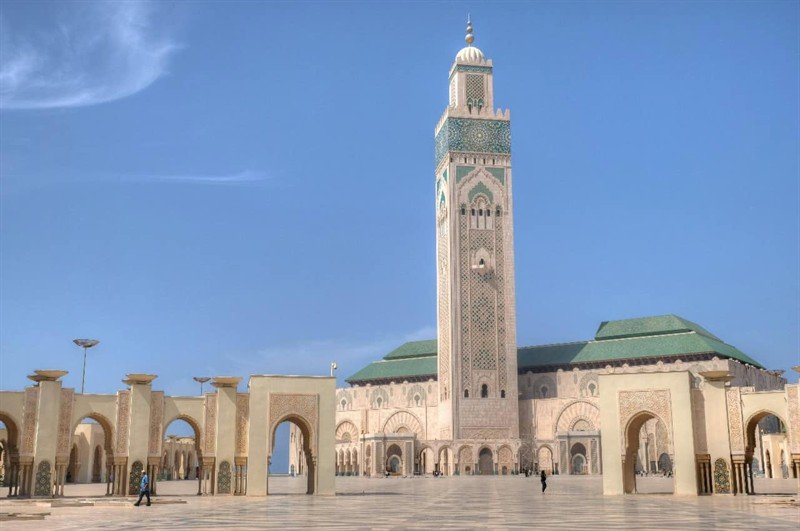
After meeting your driver at Mohammed V airport, you visit the Hassan II Mosque, built partly over the Atlantic and one of the largest mosques in the world, with a minaret that rises above the whole city. Then a drive along the Corniche, a walk in the Habous quarter and dinner by the sea before your first night in Morocco.
Day2
Casablanca – Rabat
The capital: the Hassan Tower and the Kasbah of the Oudayas.
A short drive along the coast brings you to Rabat, the elegant and calm capital of Morocco. You visit the unfinished Hassan Tower and the marble mausoleum of Mohammed V, guarded by the royal guard, then walk through the blue and white lanes of the Kasbah of the Oudayas, with its Andalusian garden and views over the ocean and the river.
Day3
Rabat – Asilah – Tangier
The Atlantic coast to the gateway of Africa.
The road follows the Atlantic north to Asilah, a small white town inside Portuguese ramparts, decorated with murals painted by artists every summer. After a walk and a seafood lunch you continue to Tangier and its medina overlooking the Strait of Gibraltar.
Day4
Tangier – Chefchaouen
The medina of Tangier and the road into the Rif.
Before leaving Tangier you can stop at Cape Spartel, where the Atlantic meets the Mediterranean, and the Caves of Hercules. Then the road heads south-east through Tetouan and climbs into the Rif to Chefchaouen. You arrive in the afternoon to explore the blue lanes and watch the sunset from the Spanish mosque.
Day5
Chefchaouen – Meknes – Fes
Volubilis and imperial Meknes.
After a last morning walk in the blue medina you drive south through the hills of the Rif to Volubilis, the great Roman city with its mosaics and triumphal arch. You continue to Meknes to see Bab Mansour and the royal stables, and arrive in Fes in the late afternoon.
Day6
Fes
Guided visit of the medina.
Fes el-Bali is one of the largest car-free urban areas in the world and a UNESCO World Heritage site. With a local guide you walk its maze of more than nine thousand lanes: the Bou Inania madrasa with its carved cedar and zellige tiles, the Al Quaraouiyine mosque and university, the Nejjarine fountain and the Chouara tanneries, seen from a terrace. You also meet weavers, coppersmiths and potters at work.
Day7
Fes – Merzouga
The Middle Atlas and the Ziz valley to the dunes.
Leaving Fes, you climb into the Middle Atlas to Ifrane, a surprising town with alpine roofs, and the cedar forest of Azrou, where Barbary macaques live in the wild. After lunch in Midelt, at the foot of the snowy Ayachi, the road follows the Ziz gorges and its endless palm groves past Errachidia and Erfoud to Merzouga, at the edge of the dunes.
Day8
Merzouga
4x4 tour, camel ride and night in the camp.
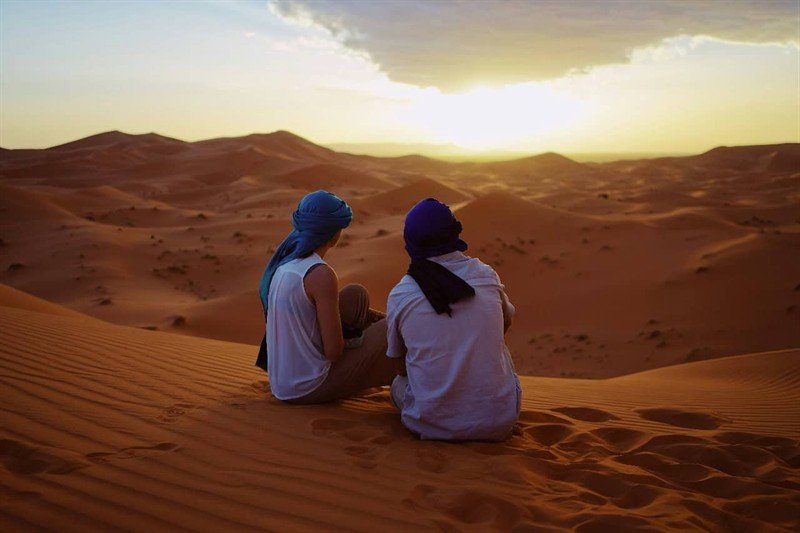
Merzouga is the gateway to Erg Chebbi, a sea of orange dunes up to 150 metres high. By 4x4 you visit a nomad family for tea, the village of Khamlia, where Gnawa musicians of sub-Saharan origin play their hypnotic music, the seasonal lake and the black stone desert. In the late afternoon a camel caravan takes you into the dunes for sunset and the night in the camp, with dinner, drums around the fire and a sky full of stars.
Day9
Merzouga – Todra – Dades
Sunrise, the gorges and the Dades valley.
Wake up early to watch the sunrise from the top of a dune, then ride back to the village for breakfast and a shower. The road west passes Rissani, the old capital of the Tafilalet with its busy market, and the oases of Tinejdad. In the afternoon you walk in the Todra gorges and continue to the Dades valley, famous for its winding road and rock formations.
Day10
Dades – Skoura – Ouarzazate
The Rose Valley and the palm grove of Skoura.
A gentle day on the road of the kasbahs. You stop in Kalaat M'Gouna, the town of the roses, and walk among the palm trees and kasbahs of Skoura, including the beautiful Amridil. In the afternoon you reach Ouarzazate, where you can visit the kasbah of Taourirt or the film studios.
Day11
Ouarzazate – Ait Ben Haddou – Marrakech
The ksar and the Tizi n'Tichka pass.
A short drive from Ouarzazate brings you to Ait Ben Haddou, where you walk up through the ksar to the old granary at the top for the view over the valley. Then the road climbs the Tizi n'Tichka pass and descends through Berber villages and argan cooperatives to Marrakech.
Day12
Marrakech
Guided visit of the red city.
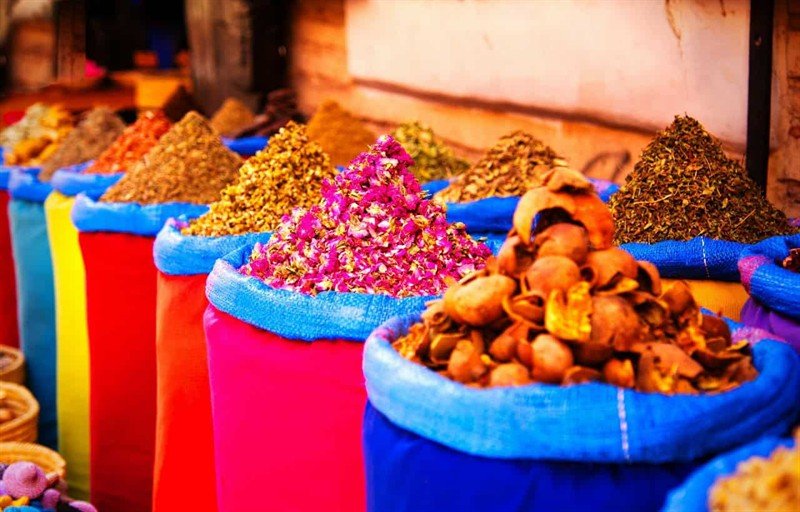
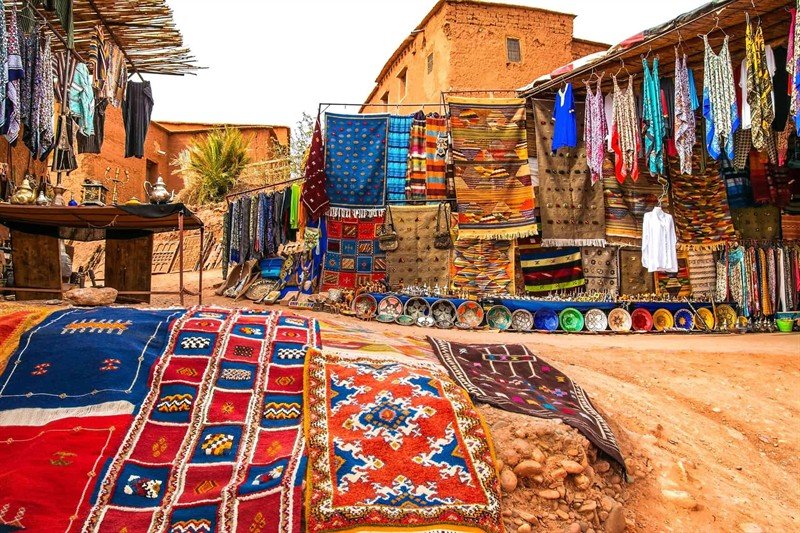
With a licensed local guide you discover the essentials of the red city: the minaret of the Koutoubia, the painted ceilings and gardens of the Bahia Palace, the Saadian Tombs and the old Jewish quarter of the Mellah. In the afternoon you get lost in the souks of spices, leather, lanterns and carpets, and at sunset you watch Jemaa el-Fna fill with life from a café terrace.
Day13
Marrakech
A free day in Marrakech.
A day to enjoy Marrakech at your own pace. You can visit the Majorelle Garden and the Yves Saint Laurent Museum, relax in a traditional hammam, join a Moroccan cooking class or simply shop in the souks. If you prefer, we can organise an excursion to the Agafay stone desert or the Atlas valleys.
Day14
Marrakech – Essaouira
The argan road to the sea.
The road west crosses the plains to the argan forest, where you may see goats climbing the trees and can visit a women's cooperative that makes argan oil by hand. In Essaouira, the wind and the sea welcome you to a relaxed medina of white houses and blue shutters, with the fishing port and the Skala ramparts.
Day15
Essaouira – Casablanca
The coast road and transfer to the airport.
The coast road north passes small fishing towns and the lagoon of Oualidia, famous for its oysters, and the Portuguese city of El Jadida with its underground cistern. You arrive in Casablanca in the afternoon for a final visit of the Hassan II Mosque or your transfer to the airport.
Included
Pick-up and drop-off at your hotel, riad or the airport
Private air-conditioned 4x4 or minivan
Professional driver who speaks several languages
Fuel, tolls and parking
Nights in hand-picked hotels, riads or kasbahs
Breakfast and dinner every night
Camel ride into the dunes at sunset
Night in a desert camp
Not included
Lunches
Drinks
Entrance fees to monuments
Local city guides (on request)
Tips and personal expenses
Good to know
This is a private tour: only your group travels in the vehicle. You can add days, change cities or choose the level of the hotels.
The price depends on the number of travellers and the hotels you choose. Ask us and we will send you the exact price.
Frequently asked questions
Are the tours private?
Yes. Only your group travels in the vehicle, with your own driver. We do not run shared tours.
How much does a tour cost?
The price depends on the number of travellers, the season and the level of accommodation. Send us your dates and we will reply with a clear price.
Can I change the itinerary?
Of course. You can add days, start or finish in another city, or choose different hotels. Every tour can be adapted.
What is the desert camp like?
Our camps in Merzouga have tents with real beds, dinner and breakfast. Luxury tents with private bathroom are available on request.
When is the best time to travel?
Spring (March–May) and autumn (September–November) are ideal. Winter days are sunny but desert nights are cold; summer is very hot in the south.